
India’s investment landscape is undergoing a significant transformation, driven largely by the participation of two influential demographic segments Generation Z and Millennials.While both generations exhibit greater financial awareness and technological adaptability than their predecessors, their approaches to investing, levels of risk tolerance, and long-term financial objectives display notable distinctions. Understanding these generational differences is essential for both investors and financial advisors seeking to optimise investment strategies.
Millennials, born between 1981 and 1996, entered adulthood during periods of economic uncertainty, including the 2008 global financial crisis, which has shaped their cautious and measured investment approach. They tend to favour diversified portfolios with a balanced mix of mutual funds, fixed-income products, gold, and real estate, supported by moderate equity exposure, aligning their strategies with traditional long-term goals such as home ownership, children’s education, and retirement security.
In contrast, Generation Z, born between 1997 and 2012, has grown up in a fully digital world with instant access to information and investment opportunities, fostering a greater appetite for risk and a preference for growth-oriented strategies such as direct equities, thematic funds, and emerging asset classes like cryptocurrencies. Their investment objectives are often more flexible and lifestyle-driven, with an emphasis on short- to medium-term goals such as travel, entrepreneurship, and personal development, supported by adaptable financial plans that can shift with evolving opportunities and priorities.
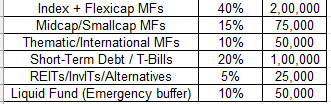
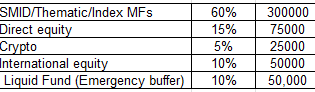
Imagine both a 35-year-old Millennial and a 23-year-old Gen Z investor each have ₹5 lakh to invest.

Millennial Approach: They allocate 40% (₹2 lakh) to equity mutual funds, 30% (₹1.5 lakh) to fixed deposits and bonds, 20% (₹1 lakh) to gold, and 10% (₹50,000) to direct equities. This diversified portfolio aims to balance growth with stability, prioritising steady returns and capital preservation over the long term.

Gen Z Approach: They invest 60% (₹3 lakh) directly into equities, 25% (₹1.25 lakh) into thematic mutual funds (e.g., technology or ESG funds), and 15% (₹75,000) into high-risk emerging assets like cryptocurrencies. This allocation reflects a higher tolerance for volatility in exchange for the potential of rapid wealth creation, with flexibility to adjust as market trends shift.
Nisreen’s Nugget:
Your investment journey is a reflection of both your personality and your priorities. Millennials, shaped by economic uncertainty in their early years, often choose the steady climb favouring diversified portfolios and gradual wealth accumulation. Gen Z, on the other hand, embraces the digital age’s speed and accessibility, often leaning into higher-risk, higher-reward strategies.
Neither approach is inherently right or wrong; the key lies in balance. The most successful investors know when to sprint toward opportunities, when to slow down for stability, and how to adjust their pace without losing sight of their long-term destination. Investing isn’t about fitting into a generational stereotype, it's about making intentional choices that serve your life goals today and decades from now.
MoneyWorks Financial Services 📍 Office Address: 1st Floor, Unit-2 Guinea Paradise JP Road, Seven Bungalows, opposite Presto Laundry, Versova, Andheri West, Mumbai, Maharashtra 400061
📞 Call us: +91 98197 74132 📩 Email: support@moneyworks.co.in
💬 Prefer WhatsApp? +91 98197 74132
🔗 Follow us on social media for more insights:
www.moneyworks.co.in


@moneyworks_financialservices
 MoneyWorks Financial Services
Terms and Conditions:
The content of this newsletter is for informational purposes only and does not constitute financial, investment, tax, or legal advice. All investment decisions should be made based on your personal financial goals, risk tolerance, and after consulting a qualified financial planner.
Mutual fund investments are subject to market risks, read all scheme-related documents carefully before investing. Past performance is not indicative of future results. MoneyWorks Financial Services and its representatives are not liable for any losses or damages arising from the use of this content. While we strive for accuracy, we do not guarantee the completeness or timeliness of any information.


.svg?v=b58db56280)
