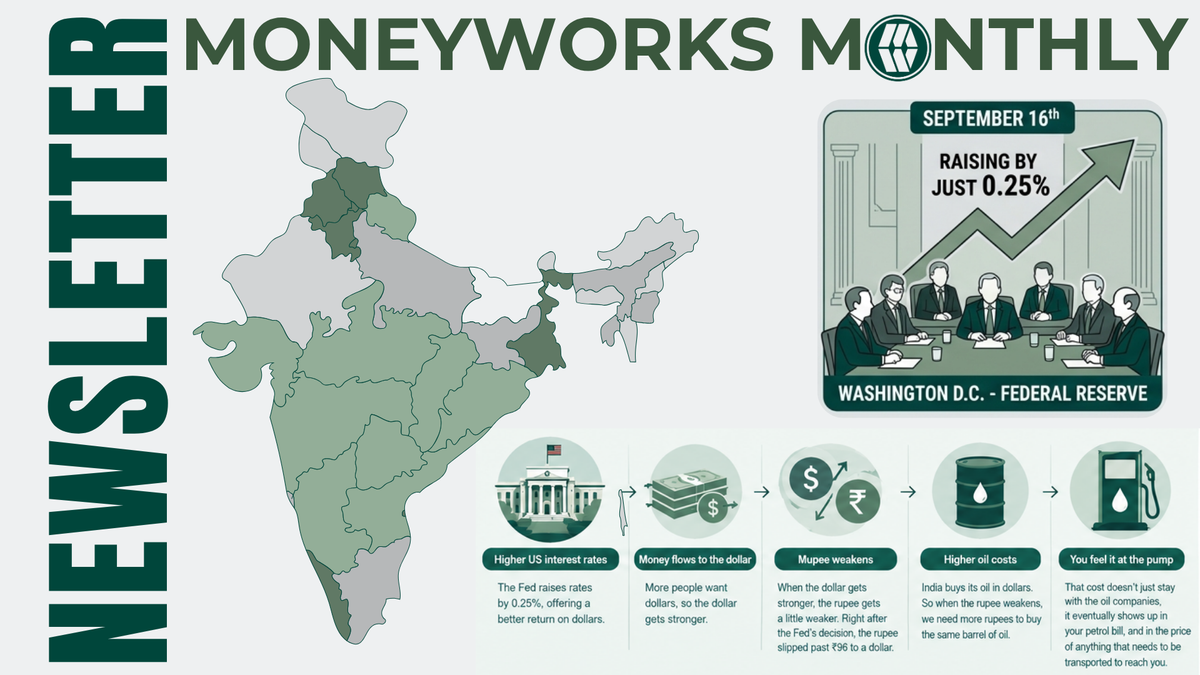
Picture this: on September 16th, a group of people sitting in a room in Washington DC decided to raise a number by a quarter of a percent. Just 0.25%. It doesn't sound like it should matter to anyone in India.
But two weeks later, if you filled up your car, checked your portfolio, or noticed the news talking about the rupee, you were feeling the ripple from that room.
Here's the story of how that happened.
Why Your Rupee Suddenly Buys a Little Less
Imagine a bank close to you suddenly started offering a much better interest rate on fixed deposits than every other bank around it (assuming the same risk). You would want to move your savings there too, so would everyone else. That's roughly what just happened on a global scale. When America raises its interest rates, it's like they just started offering a better "FD rate" on money parked there. So a lot of money starts moving toward the dollar.
When more people want dollars, the dollar gets stronger (supply and demand). And when the dollar gets stronger, the rupee gets a little weaker in comparison. Right after the Fed's decision, the rupee slipped past ₹96 to a dollar.
Here's where it hits home: India buys its oil in dollars. So when the rupee weakens, we need more rupees to buy the same barrel of oil we always have. That cost doesn't just stay with the oil companies, it eventually shows up in your petrol bill, and in the price of anything that needs to be transported to reach you.
Why Foreign Investors are Quietly Packing up
Now imagine you're a large foreign investor with money in Indian stocks. Suddenly, America is offering a safer, higher return than before. Some of that money starts heading back home, out of Indian markets and into US ones.
This isn't a story, it already happened. In just the first two weeks of September, foreign investors pulled around ₹13,138 crore out of Indian equities. When a big chunk of money exits at once, it can shake the market for a while, even though nothing about India's actual growth story has changed.
Nisreen’s Nugget
Cycles like this one are not new, and they will not be the last. India has weathered multiple Fed tightening cycles before, and each time, the underlying growth story consumption, domestic investment, and a young workforce has remained intact well after the volatility faded.
The investors who have built real wealth through these cycles were rarely the ones tracking every Fed announcement. They were the ones who stayed invested with discipline while the market reacted to short-term noise. That distinction matters more than most headlines suggest.
So the next time you hear "the Fed raised rates" on the news, you don't need to panic, and you don't need to fully understand it either. You just need to know this: it's one more reason to make sure your money isn't sitting exposed to a storm you can't control and one more reason to have a conversation with someone who can help you check.
[Book your mid-year portfolio review →https://www.moneyworks.co.in/contact]
Team MoneyWorks | Financial Sarathi — Your partner in holistic financial planning
MoneyWorks Financial Services 📍 Office Address: 1st Floor, Unit-2 Guinea Paradise JP Road, Seven Bungalows, opposite Presto Laundry, Versova, Andheri West, Mumbai, Maharashtra 400061
📞 💬 +91 98197 74132
📩 support@moneyworks.co.in
🔗 Follow us on social media for more insights:
www.moneyworks.co.in


@moneyworks_financialservices
 MoneyWorks Financial Services
Terms and Conditions:
The content of this newsletter is for informational purposes only and does not constitute financial, investment, tax, or legal advice. All investment decisions should be made based on your personal financial goals, risk tolerance, and after consulting a qualified financial planner.
Mutual fund investments are subject to market risks, read all scheme-related documents carefully before investing. Past performance is not indicative of future results. MoneyWorks Financial Services and its representatives are not liable for any losses or damages arising from the use of this content. While we strive for accuracy, we do not guarantee the completeness or timeliness of any information.


.svg?v=_NcEOCwORUMErDm9)
