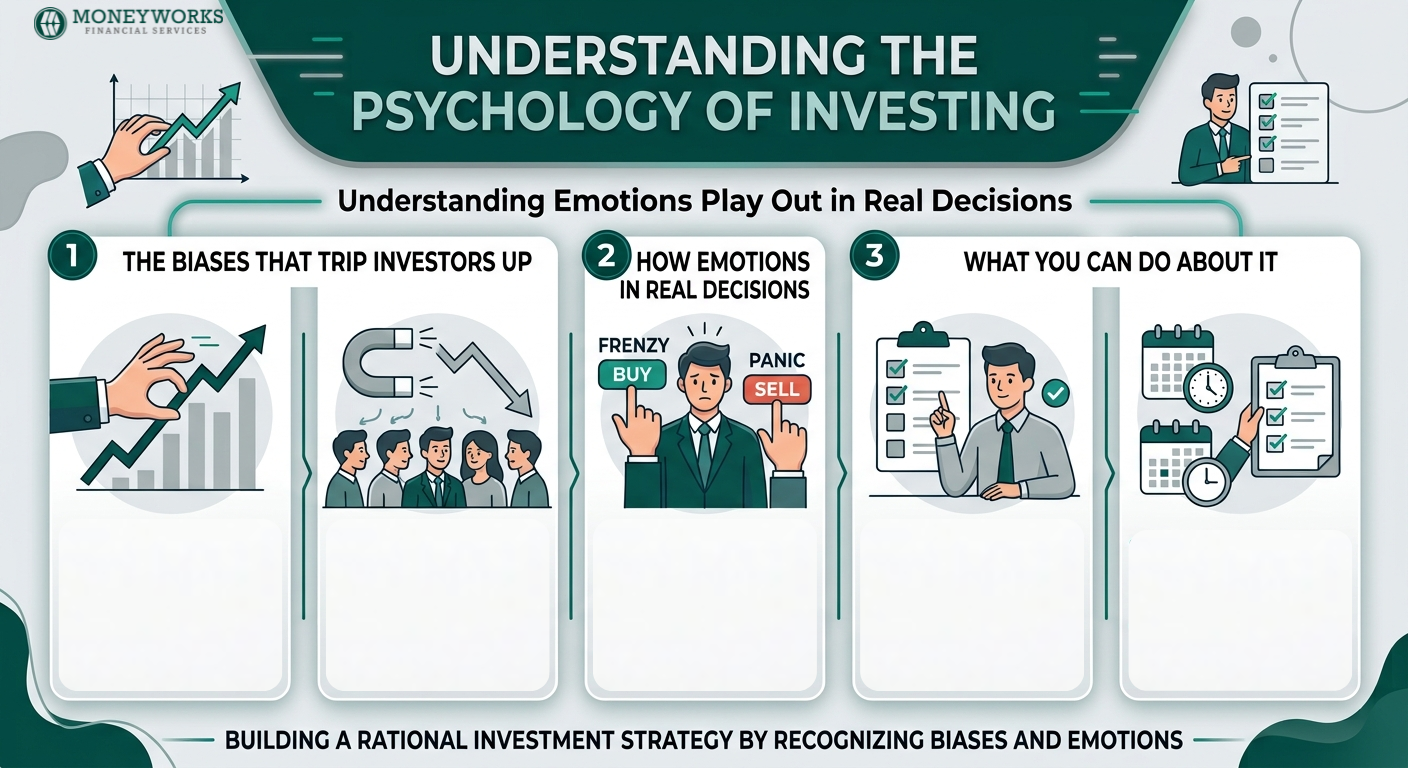
You've done the research. You've picked a solid fund. And then the market dips and suddenly, everything in you wants to pull out and wait for things to "calm down."
Sound familiar? That's not a lack of knowledge. That's behavioural finance at work.
What Is Behavioural Finance?
Behavioural finance is the study of how our emotions, psychology, and mental shortcuts influence the financial decisions we make. Traditional finance assumes investors are rational. Behavioural finance acknowledges the truth we're human, and humans feel things.
Fear, greed, overconfidence, and regret don't just affect our personal lives. They quietly shape how we invest, when we sell, and what we avoid often to our own financial detriment.
The Biases That Trip Investors Up
Most of us are affected by at least one of these without even realising it.
Loss Aversion is perhaps the most common. We feel the pain of losing ₹10,000 far more intensely than the pleasure of gaining the same amount. The result? Holding on to a losing investment far longer than we should, hoping it comes back, rather than cutting our losses and moving on.
Overconfidence Bias kicks in when markets are doing well. Investors start to believe they have a special ability to read the market, concentrate heavily in a single stock, and take on more risk than their situation warrants. Until it doesn't work out.
Confirmation Bias is subtler. It's the tendency to seek out information that supports what we already believe and ignore the warning signs. Own a stock you love? You'll probably scroll past the negative analyst reports.
Herd Mentality is what happens during every market rally and every crash. When everyone around you is buying, it feels irrational to sit still. When everyone is selling, staying calm feels almost impossible. But following the crowd is one of the most reliable ways to buy high and sell low.
How Emotions Play Out in Real Decisions
Consider what happens during a market downturn. Fear takes over, and many investors panic-sell locking in their losses at exactly the wrong moment. Those who stayed invested typically recovered and went on to benefit as markets rebounded.
Or think about a market rally. Stocks are trending, friends are talking about returns, social media is full of success stories. Greed and excitement push investors to buy popular stocks at peak prices only to face losses when sentiment shifts.
The SIP example is particularly instructive. During a period of market correction:
- Investor A continues their SIP buying more units at lower prices, positioning themselves well for the recovery.
- Investor B stops out of fear missing the opportunity entirely and often re-entering only after prices have risen again.
The difference between these two investors isn't intelligence or income. It's discipline.
What You Can Do About It
Awareness is the first step. Simply knowing that you are wired to react emotionally to markets and that this is normal already gives you an edge.
Beyond awareness, a few practical principles help:
Stick to a plan. A well-constructed financial plan acts as an anchor when emotions pull you in different directions. Your plan was built on logic. Trust it when emotion makes that difficult.
Don't check your portfolio too often. The more frequently you look, the more likely short-term fluctuations are to trigger a reaction. Long-term investors should be reviewing periodically, not daily.
Automate where possible. SIPs work precisely because they remove the decision. You invest consistently regardless of what the market is doing, which naturally averages out your cost over time.
Talk to a professional. A good financial advisor doesn't just recommend products they help you stay rational when the market makes that hard. They provide perspective when fear or greed is clouding your judgement, and they keep your portfolio aligned with your actual goals rather than your current emotions.
The Bottom Line
Markets will always move up and down. What separates investors who build wealth over time from those who don't is rarely the funds they picked it's how they behaved when things got uncomfortable.
Disciplined, long-term investing consistently outperforms emotional, reactive decision-making. Understanding your own behavioural biases is one of the most valuable things you can do for your financial future.
Control your emotions. Invest for the long term.
MoneyWorks Financial Services 📍 Office Address: 1st Floor, Unit-2 Guinea Paradise JP Road, Seven Bungalows, opposite Presto Laundry, Versova, Andheri West, Mumbai, Maharashtra 400061
📞 💬 +91 98197 74132
📩 support@moneyworks.co.in
🔗 Follow us on social media for more insights:
www.moneyworks.co.in


@moneyworks_financialservices
 MoneyWorks Financial Services
Terms and Conditions:
The content of this newsletter is for informational purposes only and does not constitute financial, investment, tax, or legal advice. All investment decisions should be made based on your personal financial goals, risk tolerance, and after consulting a qualified financial planner.
Mutual fund investments are subject to market risks, read all scheme-related documents carefully before investing. Past performance is not indicative of future results. MoneyWorks Financial Services and its representatives are not liable for any losses or damages arising from the use of this content. While we strive for accuracy, we do not guarantee the completeness or timeliness of any information.


.svg?v=_NcEOCwORUMErDm9)
